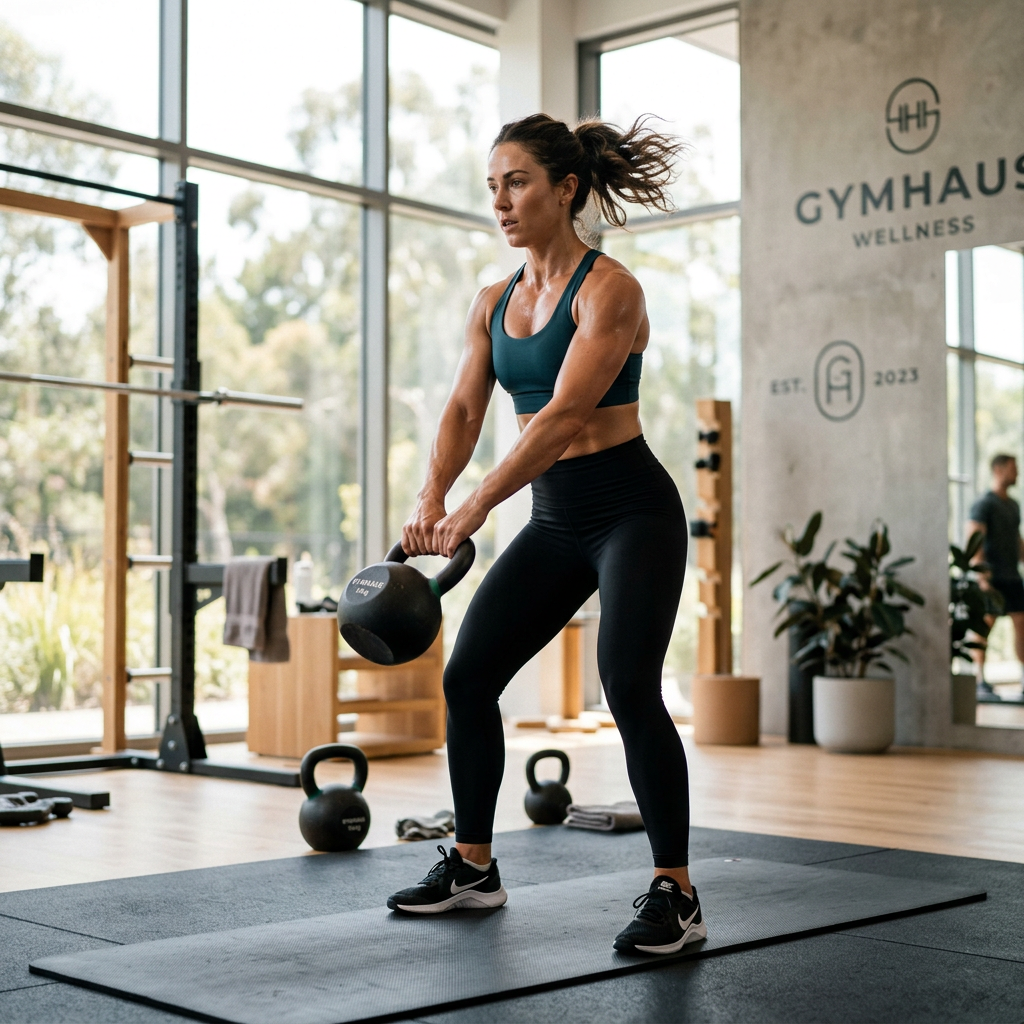
This 30-minute beginner home workout includes three rounds of eight bodyweight exercises: bodyweight squats, incline push-ups, reverse lunges, glute bridges, wall sits, dead bugs, standing marches, and forearm or knee planks. It requires no equipment, takes 30 minutes total, and is designed for adults who haven’t trained consistently in six months or more.
Most beginner workout plans fail for the same reason: they ask you to do too much, in too many sessions, with equipment you don't own. This one doesn't. It's three rounds, eight bodyweight exercises, thirty minutes start-to-finish, and the only thing you need is a patch of floor about the size of a yoga mat.
We point patients toward this routine in the first month of a GLP-1, TRT, or HRT protocol. Not because it's the only workout that works — it's not — but because it's the one most people will actually do three times a week without quitting. And consistency beats intensity every time when you're starting out.
Who this 30-minute workout is actually for
This routine is built for adults who haven't trained consistently in 6+ months, who want a full-body session they can do at home, and who need it to be short enough to finish on a busy weekday. It is appropriate for most healthy adults age 18–70.
It is especially useful if you're on a GLP-1 medication (semaglutide or tirzepatide) and trying to preserve lean muscle while losing fat — a known concern when caloric intake drops fast. Published evidence from the STEP-1 and SURMOUNT-1 trials shows roughly 20–40% of weight lost on GLP-1 medication comes from lean mass when no resistance training is added. Even two short bodyweight sessions a week meaningfully blunts that.
Who should skip it: anyone with unmanaged cardiovascular disease, recent surgery, acute joint injury, or who has been told by a clinician to avoid resistance training. If you're pregnant, recovering from a recent illness, or under cardiology supervision, run this past your clinician first.
The 30-minute structure at a glance
- Minutes 0–4 · Warm-up. Easy movement to raise core temperature and lubricate the joints. Marching in place, shoulder rolls, hip circles, bodyweight squats to depth (3–5 reps, easy).
- Minutes 4–26 · Three rounds. Eight exercises per round. 40 seconds work, 20 seconds rest between exercises. 60 seconds rest between rounds.
- Minutes 26–30 · Cool-down. Slow walk in place, hip-flexor stretch, chest stretch in a doorway, neck rolls.
That's it. No app required, no timer purchase needed — your phone clock works.
The eight exercises, in order
Do them in this order. The sequence alternates lower-body, upper-body, and core so no single muscle group fatigues before you get through a round.
1. Bodyweight squat
Feet shoulder-width, toes slightly turned out. Sit back like you're lowering onto a chair, knees tracking over your toes (not collapsing in). Stand tall, squeeze your glutes at the top. Aim for thighs parallel to the floor; if you can't get there yet, go as low as you can with a flat back.
2. Incline push-up
Hands on a countertop, sturdy table, or sofa armrest. Body in a straight line from shoulder to ankle, lower chest to surface, push back up. The higher the surface, the easier the push-up. Drop the surface lower as you get stronger. Never let your hips sag.
3. Reverse lunge (alternating)
Stand tall, step one foot straight back, lower until the back knee hovers an inch above the floor, return. Alternate legs. If balance is the limiting factor, hover your fingertips on a wall.
4. Glute bridge
Lie on your back, knees bent, feet flat. Drive through your heels and lift your hips until your body forms a straight line from knee to shoulder. Squeeze your glutes — not your low back — at the top. Pause for one second.
5. Wall sit
Back against a wall, slide down until your thighs are parallel to the floor (or as close as you can get). Hold. This one is brutal in the best way — you'll feel it in your quads almost immediately.
6. Dead bug
Lie on your back, arms straight up, knees bent at 90°. Slowly extend your right arm overhead and left leg out straight, keeping your low back glued to the floor. Return, switch sides. The slower you go, the harder it is.
7. Standing march
Stand tall. Drive one knee up to hip height, lower it, drive the other up. Pump your arms like you're running. Light cardio between strength moves — this is what keeps your heart rate elevated.
8. Forearm plank (or knee plank)
Forearms on the floor, body in a straight line from heels to head. If a full plank is too much, drop to your knees and keep the line from knees to head straight. Squeeze your glutes, breathe normally.
How hard should it actually feel?
Use the Borg RPE scale — a six-to-twenty self-rating of perceived exertion validated since 1982 and still the most-cited tool in clinical exercise physiology. For a beginner workout, you want to live in the 12–14 range, which translates to "somewhat hard" — you can talk in short sentences but not hold a conversation.
If you finish round one feeling like it was easy, the form is probably wrong. If you can't finish round two without stopping mid-round, the intensity is too high. Aim for "I could do one more round if I had to, but I'm glad I don't."
The CDC's adult physical-activity guidelines target 150 minutes of moderate-intensity activity per week plus two muscle-strengthening sessions. Three of these workouts hits both boxes — 90 minutes of moderate-intensity work and three resistance sessions.
How often to do it
Beginners: three times a week, non-consecutive days. Monday, Wednesday, Friday is the classic template. Take Saturday and Sunday off, or fill them with a 20-minute walk.
Skip the temptation to add a fourth or fifth session in the first two weeks. The most common reason new exercisers quit is soreness, and the most common cause of soreness is going from zero sessions to five overnight. Three sessions a week for a month, then we add a fourth.
The three mistakes that wreck progress in week one
- Going too hard on session one. If you can barely walk on Tuesday, you'll skip Wednesday. The first two weeks should leave you feeling worked, not destroyed.
- Skipping the warm-up. Four minutes of easy movement before round one cuts injury risk and meaningfully improves the work you do in rounds two and three.
- Eyeballing form. Set up your phone on a stack of books and film one full round. Watch it back. The thing you're sure is fine is almost always the thing you need to fix.
When to skip a session (and not feel guilty)
Skip it if you slept less than five hours, if your resting heart rate is more than 10 beats above normal, if you have a fever, or if a joint hurts at rest. None of those are quitting. They're recovery debt, and training through them will set you back further than the missed session would.
Everything else — busy week, tired, "not feeling it" — do the 30 minutes anyway. The version of you on the other side of the workout has never once regretted finishing it.
Start a clinician-built GLP-1 protocol.
If you're pairing this workout with a weight-loss medication, the goal is to lose fat without losing muscle. We build personalized GLP-1 plans (compounded semaglutide or tirzepatide) with a Care Coach who keeps the protein and training side dialed in.
See if you qualify →Editorial disclosure: This article is for informational purposes only and does not constitute medical advice. All treatments at DirectCare AI are prescribed by US-licensed clinicians based on individual medical evaluation. Compounded medications are not FDA-approved and are not reviewed by the FDA for safety, effectiveness, or quality. Always consult a US-licensed clinician before starting or changing any therapy.