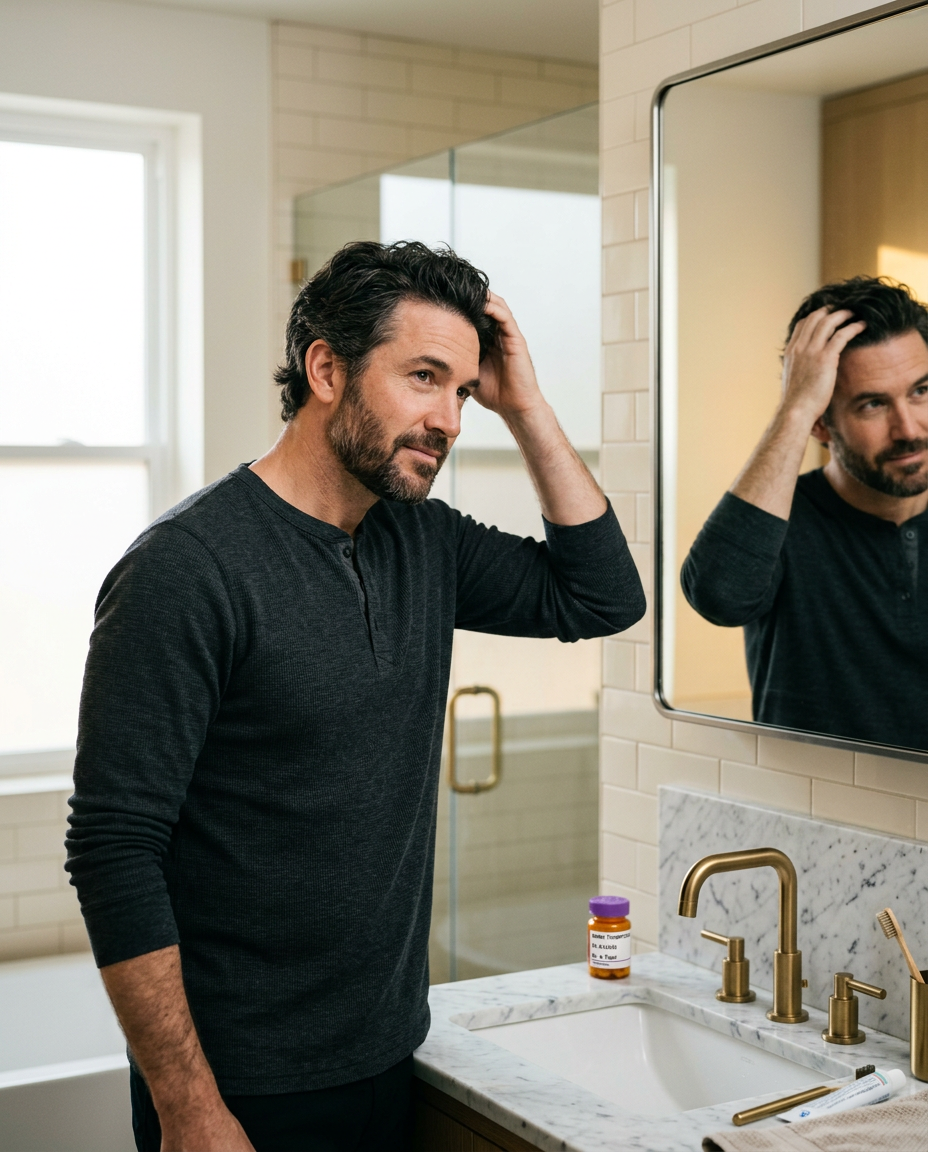
If you've been on finasteride for a year and your hairline is still receding, the next question your clinician should be asking is whether you need a stronger DHT blocker — not a different vitamin. Dutasteride is that stronger drug. It's more aggressive by design, and for the right patient, that aggression is the point.
But "more aggressive" cuts both ways. Here's what actually changes when you move from finasteride to dutasteride, what the trials show, and how to decide whether the escalation makes sense for your scalp.
What both drugs are actually doing
Male pattern hair loss (androgenetic alopecia) is driven by dihydrotestosterone — DHT — binding to receptors in genetically susceptible follicles on the scalp. DHT miniaturizes those follicles over time. Thinner hairs, shorter cycles, eventual dormancy.
DHT is made from testosterone by an enzyme called 5-alpha reductase (5-AR). That enzyme comes in two main isoforms: type 1 (mostly skin and sebaceous glands) and type 2 (mostly scalp, prostate, and reproductive tissue).
- Finasteride blocks only type 2.
- Dutasteride blocks both type 1 and type 2.
That's the whole mechanistic story. Everything downstream — the efficacy gap, the side effect gap, the price gap — flows from that single difference.
How much stronger is dutasteride, in plain English
Finasteride at 1 mg/day suppresses serum DHT by roughly 70%. Dutasteride at 0.5 mg/day suppresses it by around 90–95%. In scalp tissue specifically, the gap is even wider because type 1 is present locally.
The head-to-head trial most clinicians reference is Olsen et al. (2006) and the later Phase III work by Harcha et al. (2014), which compared dutasteride 0.5 mg to finasteride 1 mg over 24 weeks in men with androgenetic alopecia. Dutasteride produced significantly greater hair count increases at 12 and 24 weeks, and better investigator-rated improvement.
A 2019 meta-analysis in the Journal of the American Academy of Dermatology pooled the available RCTs and found dutasteride superior to finasteride on hair count, hair width, and global assessment — with the caveat that the absolute difference, while real, is modest for many men.
Translation: dutasteride isn't a different category of drug. It's a stronger version of the same drug. If finasteride is working well, you probably don't need to switch. If it isn't, dutasteride is the logical next step before you start stacking oral minoxidil or considering transplants.
When aggressive is the right call
Escalation to dutasteride tends to make sense in a few specific scenarios:
- Finasteride non-responders. You've been on 1 mg daily for 12+ months with good adherence and your hair is still visibly thinning or receding. This is the classic indication.
- Fast progressors. Men in their 20s or early 30s with an aggressive Norwood trajectory — visible loss year over year — who want the strongest oral monotherapy available.
- Diffuse thinning across the crown and mid-scalp, where the local type 1 isoform contribution appears to matter more than in isolated frontal recession.
- Post-transplant maintenance, where losing native hair around grafts would compromise the surgical result.
{callout: The clinical rule of thumb} Dutasteride is not a first-line drug for most men — it's the right answer when finasteride has been given a fair 12-month trial and the mirror still says otherwise.
When finasteride is still the smarter first move
If you're new to treatment, finasteride at 1 mg/day is the reasonable starting point. It has the longest safety record, the largest evidence base, and about 80–90% of men see stabilization or improvement on it within a year (Kaufman et al., long-term follow-up data). Starting with the less aggressive option and escalating only if needed is standard clinical logic — it's how we approach blood pressure, cholesterol, and most chronic conditions.
Starting on dutasteride when finasteride would have worked means you're accepting more side-effect risk for a marginal efficacy gain you didn't need.
The side effect trade-off, no sugarcoating
Both drugs share the same side effect profile because they act on the same pathway. The categories are:
- Sexual side effects: decreased libido, erectile dysfunction, reduced ejaculate volume. In finasteride trials, these run around 2–4% above placebo. Dutasteride trials show similar or slightly higher rates.
- Mood effects: depression and anhedonia have been reported, though causality remains debated in the literature.
- Gynecomastia: rare, but real.
- Post-finasteride syndrome (PFS): a controversial cluster of persistent symptoms after discontinuation. The mechanism and true incidence are still being worked out. Whatever the base rate is on finasteride, it's not zero on dutasteride either.
One meaningful pharmacokinetic difference: dutasteride's half-life is roughly 5 weeks, compared to finasteride's 6–8 hours. If you develop a side effect and stop the drug, finasteride clears in days. Dutasteride can take months. That's a real consideration for anyone who wants an easy off-ramp.
Dutasteride will also suppress PSA by roughly 50%, so if you're 40+, your clinician needs to know you're on it before interpreting any future prostate screening.
What a workup before escalating looks like
Before moving from finasteride to dutasteride, the questions worth answering are:
1. Is adherence actually 100%? Missed doses are the most common cause of "finasteride not working." 2. Is the diagnosis right? Diffuse shedding in a younger man can be telogen effluvium, thyroid-driven, or iron-deficiency-driven — none of which respond to a stronger DHT blocker. 3. Are hormones and micronutrients in range? A thorough workup would typically include ferritin, TSH, free T4, vitamin D, and a basic hormone panel. If ferritin is 18 or your thyroid is off, that's your problem — not the finasteride dose. 4. Is topical minoxidil (or low-dose oral minoxidil) already on board? Combination therapy outperforms either drug alone.
If you choose to do bloodwork through us, those are the markers we'd flag first before recommending an escalation from finasteride to dutasteride. Skipping that step and just cranking up the DHT suppression is how patients end up on a stronger drug for a problem the stronger drug wasn't going to fix.
Dosing, in the published range
Dutasteride for androgenetic alopecia is used off-label in the U.S. (its FDA indication is BPH). Published trial doses range from 0.5 mg daily to 0.5 mg two or three times weekly, with daily dosing showing the strongest hair count outcomes. Some clinicians titrate down to less-than-daily dosing to reduce systemic exposure once regrowth stabilizes. Any specific regimen belongs in a conversation with your clinician, not a blog post.
Finasteride's standard hair-loss dose is 1 mg/day. Higher doses don't produce meaningfully more hair.
The honest summary
Dutasteride is finasteride with the volume turned up. Louder response, louder side effects, longer half-life. It's the right tool when the first tool wasn't enough — not the first tool you reach for.
If your finasteride year has been disappointing and you've ruled out the boring reasons (adherence, thyroid, ferritin, diagnosis), escalation to dutasteride is a defensible, evidence-backed next step. If you're just starting, start with finasteride and give it the full 12 months before you decide it failed.
Either way, the decision benefits from a clinician who's looking at your symptoms, your history, and — when you have them — your labs. Not a checkbox on a website.
Hair regrowth protocols, by your clinician.
Topical and oral finasteride, dutasteride, and minoxidil — prescribed and titrated based on what your scalp actually needs.
Start regrowth →Editorial disclosure: This article is for informational purposes only and does not constitute medical advice. All treatments at DirectCare AI are prescribed by US-licensed clinicians based on individual medical evaluation. Compounded medications are not FDA-approved and are not reviewed by the FDA for safety, effectiveness, or quality. Always consult a US-licensed clinician before starting or changing any therapy.