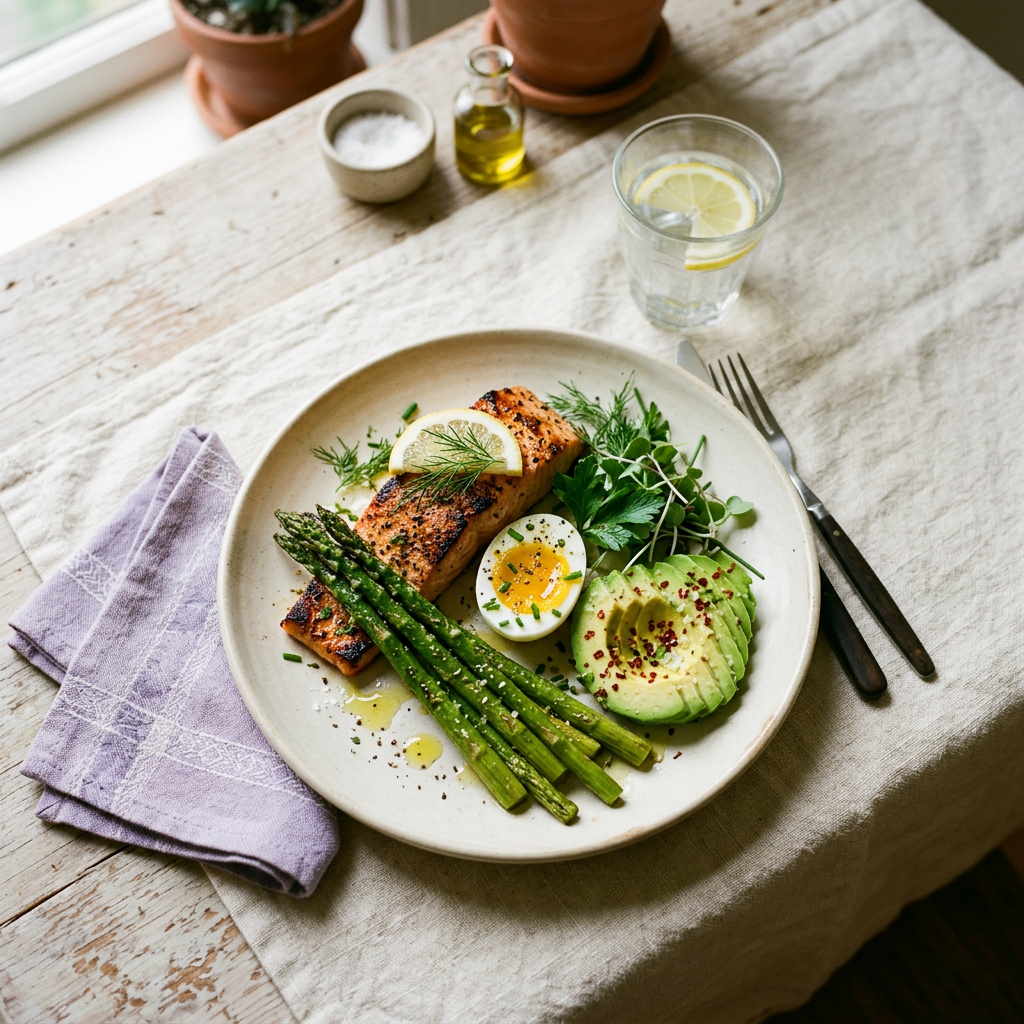
On a GLP-1 medication, consuming 25-35 grams of fiber daily from whole foods helps maintain steady appetite control, prevents constipation, and stabilizes energy levels. Without enough fiber, appetite suppression fades, leading to rebound hunger and energy crashes.
If you're on semaglutide or tirzepatide and feeling great for three days, then bloated, constipated, and weirdly ravenous by day five — the issue is almost never the medication. It's the fiber gap.
GLP-1 receptor agonists slow gastric emptying by roughly 30-70% depending on dose and timing (Maselli & Camilleri, 2021). That's the mechanism doing most of the appetite work. But slower gastric transit plus a low-fiber, low-residue diet — which is what most people default to when nauseous — is a recipe for constipation, poor satiety signaling, and blunted results by week 8.
The fix is unsexy and specific: 25-35 grams of fiber per day, mostly from food, spread across meals.
Why fiber matters more on a GLP-1, not less
Most patients assume that because a GLP-1 is doing the appetite work, food composition matters less. The opposite is true.
GLP-1s amplify the satiety signal of every meal — but that signal depends on what the meal contains. Fiber (especially viscous soluble fiber like beta-glucan from oats, or psyllium) increases the release of endogenous GLP-1 and PYY from the gut. You're essentially stacking your body's own satiety hormones on top of the medication.
Skip fiber, and you get the drug's effect alone — which fades faster between doses and leaves you white-knuckling the last 48 hours before the next injection.
What happens at under 15g of fiber a day on a GLP-1
This is the pattern we see clinically:
- Constipation by week 2-3. Gastric emptying is already slowed. Add a low-residue diet and colonic transit stalls.
- Rebound hunger between doses. Without fiber-driven PYY, appetite returns 24-36 hours earlier than it should.
- Energy crashes mid-afternoon. Refined carbs without fiber spike and drop glucose faster; the GLP-1 doesn't fully offset this.
- Muscle loss risk climbs. Low-fiber diets tend to be low-protein diets too, and inadequate protein on a GLP-1 is the fastest way to lose lean mass instead of fat.
The fiber number isn't arbitrary. The Institute of Medicine sets adequate intake at 25g/day for women and 38g/day for men. On a GLP-1, we aim for the middle of that range because total food volume is lower — you have to make each bite denser.
The 25-35g target, in plain English
Here's what 30g of fiber actually looks like across a day, at typical GLP-1 appetite levels:
- Breakfast: ½ cup rolled oats (4g) + 1 tbsp chia seeds (5g) + ½ cup raspberries (4g) = 13g
- Lunch: 2 cups mixed greens (2g) + ½ cup black beans (7g) + ½ avocado (5g) = 14g
- Snack: 1 medium pear with skin (6g) = 6g
- Dinner: 4 oz salmon (0g) + 1 cup roasted broccoli (5g) + ½ cup quinoa (3g) = 8g
That's 41g, which gives you buffer. Most patients hit closer to 30g when portions shrink on-medication, which is exactly the target.
The core ruleOn a GLP-1, every meal should contain at least one fiber-dense anchor food — beans, berries, oats, chia, avocado, or a cruciferous vegetable — before you decide what protein to add.
What about fiber supplements?
Psyllium husk (Metamucil, or generic) is legitimate and well-studied. 5-10g per day of psyllium can close a gap when appetite is genuinely too suppressed to eat 30g of food-fiber.
But supplements shouldn't be the whole strategy. Food fiber comes bundled with polyphenols, resistant starch, and micronutrients that a psyllium scoop doesn't replicate. Use the supplement as a bridge on nauseous days, not a substitute.
A note on timing: take psyllium with plenty of water (at least 8 oz), and separate it from your GLP-1 injection day meals if you're already feeling full. Fiber + slowed gastric emptying + inadequate water is how people end up in urgent care with an impaction.
Three fiber-forward meals tuned to GLP-1 appetite
These are built for the reality of eating on semaglutide or tirzepatide: small portions, protein-forward, fiber-dense.
1. Overnight oats, weaponized
Ingredients:
- ½ cup rolled oats
- 1 tbsp chia seeds
- 1 tbsp ground flaxseed
- ¾ cup unsweetened almond milk
- 1 scoop (25-30g) whey or plant protein
- ½ cup raspberries or blackberries
- Cinnamon to taste
Method: 1. Combine oats, chia, flax, and protein powder in a jar. 2. Add almond milk and stir until protein is fully dissolved. 3. Top with berries and cinnamon. 4. Refrigerate overnight (minimum 6 hours). 5. Eat cold or warm briefly; add water if too thick.
Approximate nutrition: 32g protein · 14g fiber · 38g carbs · 10g fat · 340 kcal
Variations: Swap berries for diced pear; use pumpkin puree + pumpkin pie spice in fall; add 1 tbsp almond butter for higher-fat days; use kefir instead of almond milk for extra probiotics.
2. The five-minute bean bowl
Ingredients:
- ½ cup canned black beans, rinsed
- ½ cup canned chickpeas, rinsed
- 2 cups baby spinach
- ½ avocado, diced
- 2 tbsp salsa or pico de gallo
- Squeeze of lime
- 3 oz rotisserie chicken or 2 hard-boiled eggs
Method: 1. Warm beans and chickpeas in a bowl for 60 seconds. 2. Wilt spinach directly on top with the heat. 3. Add avocado, salsa, and protein. 4. Squeeze lime over everything. 5. Eat immediately.
Approximate nutrition: 35g protein · 15g fiber · 32g carbs · 14g fat · 400 kcal
Variations: Sub lentils for chickpeas; add ¼ cup cooked quinoa for heavier days; swap chicken for grilled shrimp; add pickled jalapeños for zero-calorie flavor.
3. Sheet-pan salmon with broccoli and farro
Ingredients:
- 4 oz salmon fillet
- 1.5 cups broccoli florets
- ½ cup cooked farro (or quinoa if gluten-free)
- 1 tbsp olive oil
- Lemon, garlic, salt, pepper
- Fresh dill
Method: 1. Preheat oven to 425°F. 2. Toss broccoli in olive oil, garlic, salt, pepper. Spread on sheet pan. 3. Add salmon after 8 minutes; season with lemon and dill. 4. Roast another 10-12 minutes until salmon flakes. 5. Serve over warm farro.
Approximate nutrition: 34g protein · 9g fiber · 35g carbs · 16g fat · 430 kcal
Variations: Sub cod or halibut; use Brussels sprouts instead of broccoli; add capers and olives for a Mediterranean profile; swap farro for wild rice.
How to ramp fiber without making nausea worse
Jumping from 12g to 32g overnight will backfire. The gut microbiome needs 7-14 days to adapt, and rapid fiber increases on a GLP-1 can amplify bloating and reflux.
Add 5g every 3-4 days. Prioritize soluble fiber (oats, chia, psyllium, berries, beans) over insoluble bulk (raw kale, wheat bran) in the first two weeks. Drink at least 2-2.5 liters of water daily — fiber without water is worse than no fiber.
If constipation persists past week 3, that's when a clinician conversation is worth having. Magnesium citrate (200-400mg at night) is often the next lever, and it's cheap.
The bottom line
A GLP-1 gives you the appetite suppression. Fiber makes that suppression sustainable, comfortable, and metabolically productive. Miss the fiber target and you're paying for a medication whose best effects you're actively blunting.
Fiber isn't a side quest on a GLP-1. It's what turns the drug from a six-month sprint into a two-year protocol you can actually live inside.
If you want a workup that goes beyond weight — including markers like fasting insulin, hs-CRP, and a lipid panel that tell you whether the composition of your loss is muscle or fat — those are the numbers worth having in front of you before and during any GLP-1 protocol.
Compounded GLP-1, with clinician oversight.
DirectCare AI prescribes compounded semaglutide and tirzepatide with the nutrition guidance to make a suppressed appetite still hit protein and fiber.
See if you qualify →Editorial disclosure: This article is for informational purposes only and does not constitute medical advice. All treatments at DirectCare AI are prescribed by US-licensed clinicians based on individual medical evaluation. Compounded medications are not FDA-approved and are not reviewed by the FDA for safety, effectiveness, or quality. Always consult a US-licensed clinician before starting or changing any therapy.