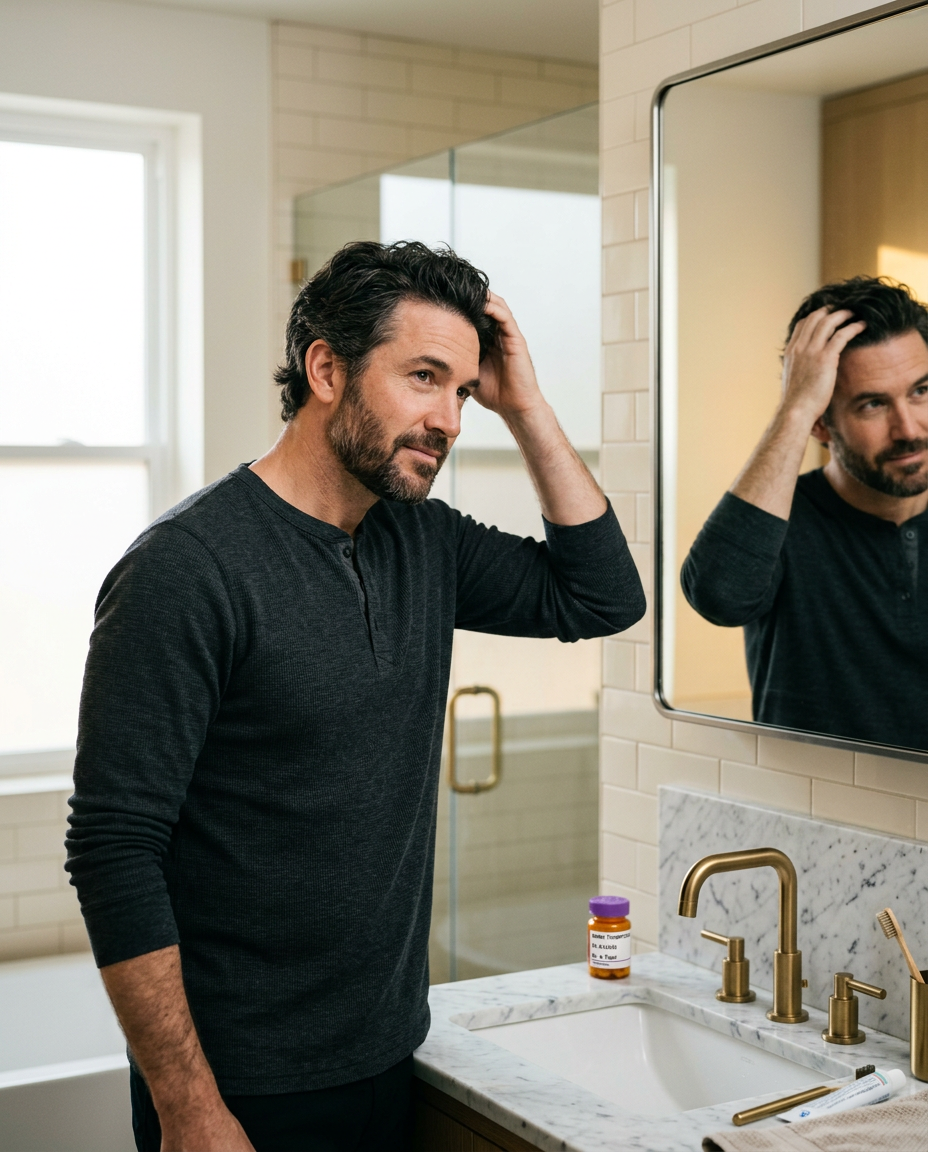
Two to six weeks into a minoxidil protocol, a meaningful number of patients see more hair in the shower drain than they have in their lives. The pillow looks worse. The shower looks worse. The brush looks worse.
Then most of them quit.
What's happening is, paradoxically, the most reliable sign the protocol is working. Here's the biology of the minoxidil shed, how to distinguish it from a real problem, and the timeline of what comes next.
What's actually happening to your hair.
Every hair on your head is in one of three phases of a 2–7 year cycle:
- Anagen (growth): active production. About 85–90% of your hair at any moment.
- Catagen (transition): the follicle stops producing. About 1–3%.
- Telogen (rest): the hair sits in the follicle but doesn't grow. About 10–15%. Telogen hairs fall out eventually (you shed 50–100 hairs per day at baseline) and a new anagen hair takes its place.
In androgenetic alopecia, this cycle is dysfunctional. Follicles spend less time in anagen, more time in telogen, and the new anagen hair that grows back is thinner and shorter than before. Eventually some follicles miniaturize past the point of producing visible hair at all.
Minoxidil's mechanism is to push follicles back into anagen — to wake them up. It does this by widening blood vessels around the follicle, modulating potassium channels, and prolonging the active growth phase.
Why this looks like more hair loss before it looks like less.
When minoxidil pushes telogen follicles toward anagen, it synchronizes the cycle. All those telogen hairs that were going to shed eventually over the next 3–4 months get pushed out at once, faster than the baseline rate. The follicle then immediately re-enters anagen and begins producing a new, thicker hair.
So in the first 2–6 weeks of minoxidil, you're losing the old, weak hair on an accelerated schedule. Underneath, the follicle is doing exactly what you started the protocol for.
How much shedding is normal
Three categories help:
- Baseline shedding: 50–100 hairs/day. Most people don't notice it.
- Minoxidil-induced shedding: a temporary increase above your baseline, typically for a few weeks. Visible on the pillow, in the shower, in the brush. Sometimes feels alarming.
- Pathologic shedding: 500+ hairs/day for more than 8 weeks, or accompanied by patchy bald spots, scalp inflammation, or systemic symptoms (fatigue, weight changes, menstrual irregularities). This warrants stopping and checking labs.
How long the shed lasts.
Standard timeline:
- Weeks 1–2: Often no visible change. The drug is loading.
- Weeks 2–6: The shed phase. Most pronounced around weeks 3–4.
- Weeks 6–10: Shed slows. Baseline shedding resumes. New hair from re-activated follicles is too short to see yet.
- Weeks 12–16: Visible new growth at the scalp — usually fine, lighter-colored "vellus" hair that matures into terminal hair over the next several months.
- Months 6–12: The visible result. Most clinical trials measure regrowth at 16 weeks and 12 months. Real-world responders typically see their best result around month 12.
How to tell normal shed from a real problem
A normal minoxidil shed:
- Starts 2–6 weeks after first application
- Lasts 2–6 weeks total
- Is diffuse (more hair everywhere, not patchy)
- Tapers and stops on its own
- Isn't accompanied by scalp pain, redness, or scaling
Reasons to actually stop and check in with a clinician:
- Shed lasts longer than 8 weeks without slowing
- Patchy bald spots (alopecia areata is a different condition entirely)
- Scalp inflammation, itching, or scaling that doesn't resolve
- Severe shedding that began before starting minoxidil and didn't change with it (suggests an upstream cause — thyroid, ferritin, hormones, post-COVID telogen effluvium — that minoxidil isn't going to fix)
- Topical irritation: redness, burning, or contact dermatitis (usually from the vehicle, not the active ingredient — a compounded formulation can resolve it)
Why this is the make-or-break moment.
Roughly 30–40% of patients who start minoxidil quit within the first 3 months. Almost all of them quit during the shed phase. Almost all of them would have responded if they'd stuck with it.
The clinical trials that demonstrate minoxidil's efficacy report results at 16 weeks and 12 months — after the shed has resolved. The drug works on a follicle-cycle timescale, not a perception timescale.
If you're going to commit to a hair-loss protocol, the agreement you make with yourself at the start should be: "I will use this consistently for 6 months before judging it." Anything less and you've quit during the part that always looks worse before it looks better.
What about oral minoxidil?
Low-dose oral minoxidil (1.25–5 mg/day) is increasingly used off-label for androgenetic alopecia, and the shed pattern is similar — sometimes more pronounced because the systemic delivery activates more follicles simultaneously. The same rules apply: shed in weeks 2–6, regrowth visible by month 4, real result at month 12.
Pair it with the rest of the protocol.
Topical or oral minoxidil rarely runs alone in our practice. Most men also get topical or oral finasteride or dutasteride to block DHT (covered in topical vs. oral finasteride). Most women get a panel-driven workup to identify the upstream cause (covered in women's hair loss isn't just male-pattern).
Both protocols produce a shed phase. Knowing it's coming and what it means is the difference between sticking with a working protocol and quitting on month two of a 12-month process.
The shed isn't the protocol failing. It's the follicles waking up. Stay on the regimen for 6 months before you judge it — the clinical trial designers knew what they were doing.
References
- Nohria A et al. Combating "dread shed": The impact of overlapping topical and oral minoxidil on temporary hair shedding during oral minoxidil initiation. JAAD Int. 2024. Source
- Kanti V et al. Evidence-based (S3) guideline for the treatment of androgenetic alopecia in women and in men - short version. J Eur Acad Dermatol Venereol. 2018. Source
Hair regrowth, by your clinician.
DirectCare AI prescribes compounded topical and oral hair-loss protocols with clinician follow-up at the 4-week and 12-week marks — so a normal shed doesn't end the regimen that would have worked.
Start hair regrowth →Editorial disclosure: This article is for informational purposes only and does not constitute medical advice. All treatments at DirectCare AI are prescribed by US-licensed clinicians based on individual medical evaluation. Compounded medications are not FDA-approved and are not reviewed by the FDA for safety, effectiveness, or quality. Always consult a US-licensed clinician before starting or changing any therapy.