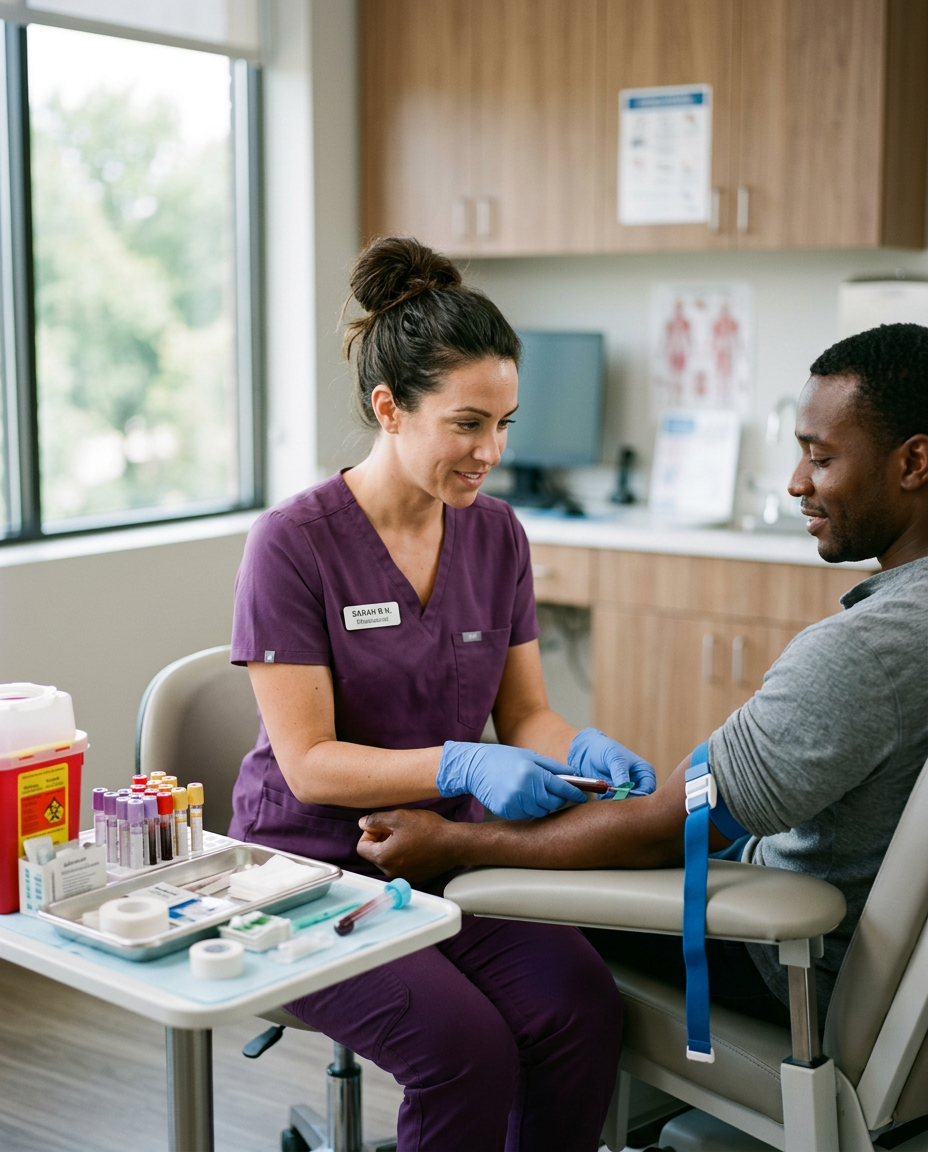
A hormone panel reveals how your endocrine system is functioning by measuring key markers like testosterone, estradiol, SHBG, LH, FSH, thyroid hormones, cortisol, and prolactin. Total testosterone alone doesn’t show the full picture—free testosterone, calculated using SHBG and albumin, reflects what your tissues actually receive. Estradiol, often overlooked in men, supports bone health and libido. LH and FSH indicate whether low sex hormones stem from testicular or brain issues. Thyroid and cortisol levels influence energy and metabolism. Prolactin, when elevated, may signal a pituitary tumor. All results must be interpreted together, with timing and context, to understand true hormonal health.
A hormone panel is one of the few lab orders where the numbers in range don't always mean the system is working. Two men can both have a total testosterone of 450 ng/dL — one feels fine, the other has the libido and energy of a houseplant. The difference is almost always in the markers nobody bothered to order, or the ratios nobody bothered to calculate.
This is a clinician's-eye walkthrough of every marker on a comprehensive hormone panel: what it measures, what the reference range hides, and what the result should make you ask next.
Total testosterone — the headline number that lies the most
Total testosterone measures every molecule of testosterone in your blood: the stuff bound to SHBG (tightly), the stuff bound to albumin (loosely), and the small free fraction.
Standard adult male reference range: roughly 264–916 ng/dL, per the CDC-harmonized assay benchmarks used by most US labs (Travison et al., J Clin Endocrinol Metab, 2017).
The problem: the range is built from a population that includes 70-year-olds and 25-year-olds. A 35-year-old man at 320 ng/dL is technically "normal" and clinically hypogonadal-feeling. The Endocrine Society uses <300 ng/dL on two morning draws as the diagnostic threshold for hypogonadism — and even then, symptoms have to match.
For women, total testosterone runs roughly 8–60 ng/dL. It matters more than most providers acknowledge for libido, energy, and lean mass.
Timing matters. Testosterone peaks between 7–10 AM. A 4 PM draw can read 100–150 ng/dL lower than the same person at 8 AM. If your result was drawn in the afternoon, it's not a real number.
Free testosterone — what your tissues actually see
Free testosterone is the unbound fraction — the only testosterone that can cross into cells and do work. It's typically 1–2% of total.
Adult male reference: roughly 47–244 pg/mL by equilibrium dialysis (the gold-standard method). Direct immunoassay free T is unreliable; if your lab used that method, treat the number with suspicion.
Most good clinicians calculate free T using total T, SHBG, and albumin via the Vermeulen equation rather than trusting a direct measurement. This is why ordering SHBG with every testosterone panel isn't optional.
SHBG — the silent variable that explains most of it
Sex hormone-binding globulin grabs testosterone and holds onto it. High SHBG means more of your total T is locked up and unusable. Low SHBG means more is free — which sounds good until you realize it usually signals insulin resistance.
Reference range: ~10–57 nmol/L for men, ~18–144 nmol/L for women (premenopausal).
- High SHBG (>60 nmol/L in men): hyperthyroidism, aging, low-calorie diets, oral estrogens, liver disease. Total T can read normal while free T is in the basement.
- Low SHBG (<20 nmol/L): insulin resistance, fatty liver, obesity, hypothyroidism, exogenous androgens.
If you only remember one thing: a testosterone number without an SHBG number next to it is incomplete.
Estradiol (E2) — the marker men ignore at their own cost
Men need estradiol. It's critical for bone density, libido, erectile function, lipid metabolism, and joint comfort. Crushing it with an aromatase inhibitor is one of the most common mistakes in poorly run TRT.
Men: target roughly 20–40 pg/mL on a sensitive (LC-MS/MS) assay. The standard immunoassay overestimates in men — always request the sensitive assay.
Women: estradiol varies wildly by cycle phase. Follicular: 30–120 pg/mL. Mid-cycle peak: 130–370 pg/mL. Luteal: 70–250 pg/mL. Postmenopausal: <30 pg/mL. A single E2 draw in a cycling woman tells you almost nothing without knowing the cycle day.
LH and FSH — the upstream signal
Luteinizing hormone and follicle-stimulating hormone come from your pituitary and tell the gonads what to do. They distinguish primary from secondary hypogonadism.
- Low T + high LH/FSH: primary (testicular) failure. The brain is shouting; the gonads aren't answering.
- Low T + low or normal LH/FSH: secondary (pituitary/hypothalamic) issue. Could be stress, opioids, prior anabolic use, prolactinoma, or sleep apnea.
Male reference: LH 1.7–8.6 mIU/mL, FSH 1.5–12.4 mIU/mL.
For women, LH and FSH only make sense in the context of cycle day or menopausal status. FSH >25 mIU/mL on day 3 of the cycle is suggestive of diminished ovarian reserve; FSH >30 mIU/mL with absent periods supports menopause.
The clinician's shortcutA complete hormone read needs at minimum: total T, free T (calculated), SHBG, estradiol (sensitive), LH, FSH, TSH, free T4, and a morning cortisol. Anything less and you're guessing.
Prolactin — the marker that catches what nobody looks for
Prolactin >25 ng/mL in men or non-pregnant women deserves a repeat draw. Persistently elevated prolactin (>50 ng/mL) warrants a pituitary MRI to rule out a prolactinoma — a benign pituitary tumor that suppresses LH, tanks testosterone, and causes low libido that won't budge no matter what dose of T you throw at it.
This is a small, cheap test that occasionally changes everything.
Thyroid panel — the hormones that masquerade as low T
Hypothyroidism produces fatigue, low libido, brain fog, weight gain, and cold intolerance — the exact symptom list patients bring to a TRT consult. You cannot read a hormone panel without thyroid context.
- TSH: 0.4–4.0 mIU/L is the standard range, though many clinicians target <2.5 in symptomatic patients.
- Free T4: ~0.8–1.8 ng/dL. The storage hormone.
- Free T3: ~2.3–4.2 pg/mL. The active hormone. Often the more useful number.
- Reverse T3 and TPO antibodies: add when symptoms don't match TSH, or when autoimmune thyroiditis (Hashimoto's) is suspected.
Cortisol and DHEA-S — the stress axis
Morning cortisol (drawn 7–9 AM) should fall between roughly 6–18 mcg/dL. Low morning cortisol with symptoms warrants an ACTH stimulation test. High cortisol — especially with central weight gain, hypertension, and skin changes — needs a Cushing's workup.
DHEA-S declines steadily with age and gives you a rough adrenal output reading. Adult reference ranges vary by age and sex; the trend matters more than the absolute number.
The supporting cast you should still order
- Fasting insulin and HbA1c: insulin resistance suppresses SHBG and crushes free T. You cannot fix hormones without fixing metabolic health.
- Lipid panel: TRT can shift HDL down; baseline numbers matter.
- CBC with hematocrit: testosterone raises red cell mass. Hematocrit >54% on therapy is a flag.
- PSA (men >40): baseline before any androgen therapy, period.
- Vitamin D (25-OH): below 30 ng/mL correlates with lower free T in multiple cohorts.
Putting it together
A hormone panel isn't a verdict — it's a map. The job is to read it in context: symptoms, history, timing, and the ratios between markers.
A 38-year-old with total T of 380, SHBG of 65, free T of 6 ng/dL, E2 of 18, and a TSH of 3.8 isn't "normal" — he's got a high-SHBG profile with borderline low free T and suboptimal thyroid, and he probably feels exactly as bad as that picture suggests. The total T number alone would have gotten him dismissed.
If you're considering hormone therapy, the labs worth having in front of a clinician before a serious protocol are the ones above — drawn in the morning, on the right assay, and read as a system rather than a single line item. That's the difference between treating a number and treating a person.
References
- Travison TG et al. Harmonized Reference Ranges for Circulating Testosterone Levels in Men of Four Cohort Studies in the United States and Europe. J Clin Endocrinol Metab. 2017. Source
- Bhasin S et al. Testosterone Therapy in Men With Hypogonadism: An Endocrine Society Clinical Practice Guideline. J Clin Endocrinol Metab. 2018. Source
Real labs. Plain-English plan.
A clinician-ordered, 80+ biomarker panel. Results in 3–5 days, with a personalized roadmap from a US-licensed clinician — not a chart you have to decode yourself.
See my numbers →Editorial disclosure: This article is for informational purposes only and does not constitute medical advice. All treatments at DirectCare AI are prescribed by US-licensed clinicians based on individual medical evaluation. Compounded medications are not FDA-approved and are not reviewed by the FDA for safety, effectiveness, or quality. Always consult a US-licensed clinician before starting or changing any therapy.