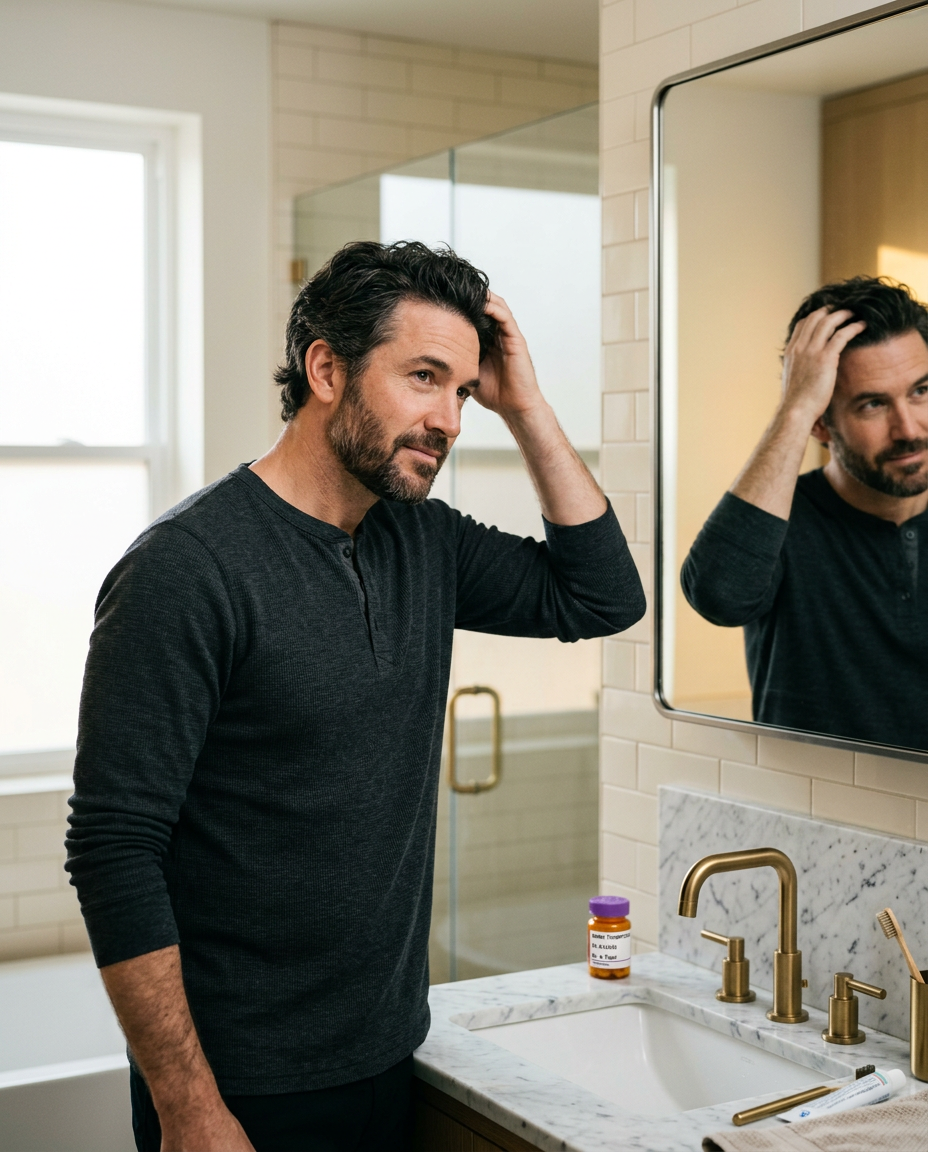
Online hair-loss care usually starts with an intake covering pattern, timeline, medications, and family history. A clinician then considers options like topical or oral minoxidil, finasteride or dutasteride, and adjuncts. Shedding may continue for 2–3 months, with visible change often taking 6–12 months in androgenetic alopecia.
Hair loss is one of the few complaints where an online visit can match an in-person one on information quality, as long as the intake is built properly. Most androgenetic alopecia — the pattern loss that accounts for the majority of adult hair thinning — is diagnosed by history and photos, with labs reserved for atypical presentations. That is why telehealth works here. What follows is the structure a careful online evaluation uses, the medications a clinician weighs, and what regrowth actually looks like across the first year.
What the intake is actually trying to figure out
what the questions are for
The intake is not paperwork. It is the differential diagnosis in disguise. A clinician reviewing your submission is sorting between a handful of causes that look superficially similar but respond to very different treatments.
The questions that carry the most diagnostic weight:
- Pattern and timeline. Receding hairline and vertex thinning over years suggests androgenetic alopecia. Diffuse shedding that started 2–4 months after a stressor (illness, surgery, childbirth, crash diet, new medication) suggests telogen effluvium. Patchy, well-defined bald spots suggest alopecia areata.
- Family history. Androgenetic alopecia is strongly heritable on both sides.
- Medications and supplements. Isotretinoin, certain antidepressants, anticoagulants, beta-blockers, and high-dose vitamin A can all drive shedding.
- Medical history. Thyroid disease, iron deficiency, recent COVID, postpartum status, and PCOS all change the picture.
- Scalp symptoms. Itch, burning, or visible scaling can point to scarring alopecias, which are a different category entirely and generally need in-person dermatology.
- Photos. Standardized photos — crown, hairline, part width, and overall — give the clinician what the eyes would see in clinic.
If you choose to do bloodwork through us, the markers worth considering before a serious protocol typically include ferritin, TSH, vitamin D, and a basic metabolic panel; in women, androgens may be added depending on the presentation. These are educational defaults, not a procedural requirement.
The options a clinician considers
not a menu, a decision
For androgenetic alopecia, the evidence base is strongest for a short list of treatments. A clinician matches them to your pattern, sex, prior response, and tolerance.
Topical minoxidil. The most studied over-the-counter option. Meta-analyses support modest regrowth and reduced shedding in both men and women with androgenetic alopecia, with effect typically visible after 4–6 months of consistent use. Local irritation and unwanted facial hair are the main side effects to watch for.
Oral minoxidil (low-dose). Increasingly used off-label at doses well below the antihypertensive range. A 2021 review in the Journal of the American Academy of Dermatology summarized growing evidence for efficacy with a generally favorable safety profile at low doses, though it can cause hypertrichosis, fluid retention, and, rarely, cardiovascular effects — which is why a clinician reviews cardiac history before considering it.
Finasteride. A 5α-reductase inhibitor that lowers scalp DHT. Systematic review data show it increases hair count and improves global assessments in men with androgenetic alopecia over 1–2 years. Sexual side effects occur in a minority of users and are a standard part of the counseling. In women, finasteride is used selectively and is contraindicated in pregnancy.
Dutasteride. A dual 5α-reductase inhibitor. A head-to-head randomized trial found greater hair count improvement than finasteride at 24 weeks in men with male-pattern hair loss. It is often considered when finasteride response is partial.
Adjuncts. Ketoconazole shampoo, microneedling, low-level laser devices, and PRP all appear in the literature with varying evidence strength. The AAD treats these as supportive rather than primary.
Treating a non-androgenetic cause instead. If the intake points at iron deficiency, thyroid dysfunction, or a drug-induced effluvium, the right move is to address the driver — not to layer a hair drug on top of it.
The honest takeawayHair-loss medications slow loss and partially regrow miniaturized follicles — they do not restart follicles that have been gone for years, and benefit stops when treatment stops.
What the first year actually looks like
month by month, without the hype
Timelines vary, but a reasonable framework for androgenetic alopecia on standard medical therapy looks like this:
Months 0–2. Little visible change. Some people experience a transient increase in shedding when starting minoxidil as follicles synchronize into a new growth cycle. This is expected, not a treatment failure, though it is uncomfortable.
Months 3–4. Shedding typically slows. New growth is often fine, short, and lighter in color at first. Photos help here because day-to-day mirror checks miss gradual change.
Months 6–8. This is the window where the AAD and the European S3 guideline note most patients can first evaluate response. Hair count and caliber improvements become more visible in standardized photos. A clinician review at this point decides whether to continue, add, or adjust.
Months 9–12. Fuller assessment of response. For patients on finasteride or dutasteride, trial data show continued gains through year one and into year two. For patients on minoxidil alone, the response plateau is typically earlier.
Regrowth is a trailing indicator. The decision to continue is made on photos and shedding, not on how your hair looked this morning.
Beyond year one. Androgenetic alopecia is chronic. Discontinuing treatment generally returns the scalp to its untreated trajectory within 6–12 months. That is a counseling point, not a scare tactic — it is simply how the biology works.
When online care is not the right fit
knowing the limits
Telehealth is well-suited to pattern hair loss with a clear history. It is less suited to:
- Scarring alopecias (lichen planopilaris, frontal fibrosing alopecia, central centrifugal cicatricial alopecia) — these need in-person exam and often biopsy.
- Rapid, patchy loss with scalp symptoms.
- Pediatric hair loss.
- Hair loss with systemic symptoms suggesting an undiagnosed endocrine or autoimmune condition.
A good online clinician refers out when the pattern does not fit. That is part of the job, not a failure of the model.
What to bring to your intake
- Four photos: hairline, crown, part, and a wide shot in consistent lighting.
- A rough timeline of when you first noticed change.
- Your current medications and supplements, including doses.
- Any prior hair-loss treatments and how long you used them.
- Recent labs if you have them.
The better the intake, the sharper the plan. Compounded formulations referenced in any treatment plan are not FDA-approved as finished products; the article disclaimer covers the specifics.
References
- Kanti V, Messenger A, Dobos G, et al. Evidence-based (S3) guideline for the treatment of androgenetic alopecia in women and in men. J Eur Acad Dermatol Venereol. 2018. Source
- Gupta AK, Charrette A. Topical minoxidil: systematic review and meta-analysis of its efficacy in androgenetic alopecia. Skinmed. 2015. Source
- Mella JM, Perret MC, Manzotti M, Catalano HN, Guyatt G. Efficacy and safety of finasteride therapy for androgenetic alopecia: a systematic review. Arch Dermatol. 2010. Source
- Olsen EA, Hordinsky M, Whiting D, et al. The importance of dual 5α-reductase inhibition in the treatment of male pattern hair loss: results of a randomized placebo-controlled study of dutasteride versus finasteride. J Am Acad Dermatol. 2006. Source
- Randolph M, Tosti A. Oral minoxidil treatment for hair loss: a review of efficacy and safety. J Am Acad Dermatol. 2021. Source
- American Academy of Dermatology Association. Hair loss: diagnosis and treatment. Source
Hair regrowth protocols, by your clinician.
Topical and oral finasteride, dutasteride, and minoxidil — prescribed and titrated based on what your scalp actually needs.
Start regrowth →Editorial disclosure: This article is for informational purposes only and does not constitute medical advice. All treatments at DirectCare AI are prescribed by US-licensed clinicians based on individual medical evaluation. Compounded medications are not FDA-approved and are not reviewed by the FDA for safety, effectiveness, or quality. Always consult a US-licensed clinician before starting or changing any therapy.