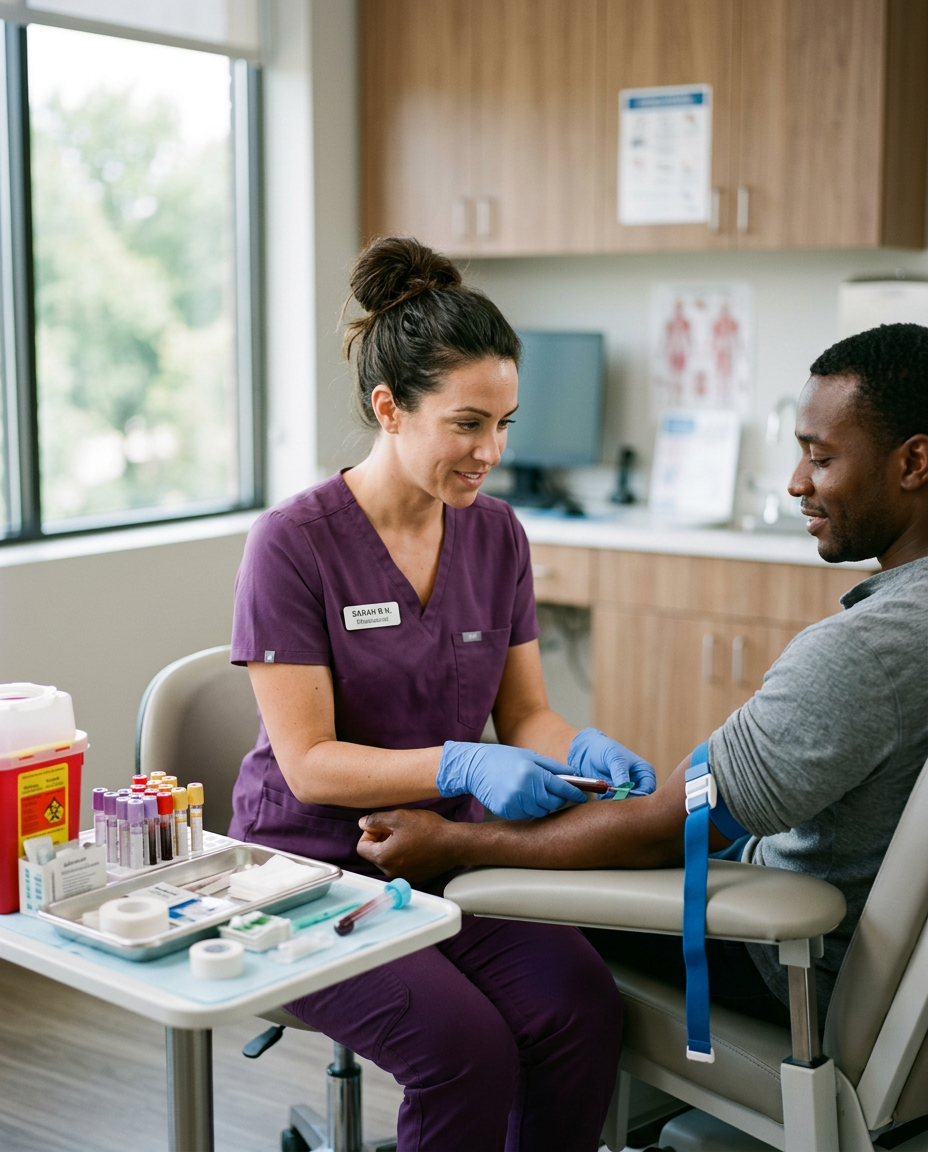
Ordering blood tests online typically means selecting a clinician-reviewed panel, visiting a partner draw site, and receiving results in a few business days. A thorough baseline usually covers metabolic, lipid, thyroid, hormone, and inflammatory markers, with reference ranges that may differ by age, sex, and lab method.
Ordering blood work used to mean a referral, a wait, and a portal message that said "normal" with no context. That has changed. Direct-to-consumer lab platforms now let you pick a panel, book a draw at a partner facility, and get results in a few business days — often with a clinician review attached.
The convenience is real. The pitfall is also real: a panel is only as useful as the markers it contains and the person reading them. Below is how a clinician actually thinks about building and interpreting a baseline panel.
What "clinician-ordered" actually means in plain English
When you order a panel online, a licensed physician in your state signs the requisition. That signature is what the lab (Quest, Labcorp, or a regional equivalent) requires to run the tests. It is not a diagnosis, and it is not a treatment plan — it is the legal order that unlocks the draw.
The second half of "clinician-ordered" is the review. A good platform routes your results back to a clinician who flags what is out of range, what is in range but trending wrong, and what warrants a follow-up conversation. Without that second step, you are essentially buying a PDF.
What belongs on a thorough baseline panel tuned to your numbers
There is no single "complete" panel, but a thorough adult baseline typically includes the following categories. The exact markers a clinician would order depend on your age, sex, symptoms, and personal and family history.
- Comprehensive metabolic panel (CMP): glucose, electrolytes, kidney function (creatinine, eGFR, BUN), liver enzymes (ALT, AST, ALP), bilirubin, albumin, total protein.
- Complete blood count (CBC) with differential: red cells, white cells, platelets, hemoglobin, hematocrit, MCV.
- Lipid panel: total cholesterol, LDL-C, HDL-C, triglycerides, and increasingly apolipoprotein B (apoB) as a more direct measure of atherogenic particle count.
- Glycemic markers: HbA1c and fasting insulin. HbA1c ≥6.5% is diagnostic for diabetes per ADA criteria; 5.7–6.4% is prediabetes.
- Thyroid: TSH as the screening test, with free T4 and sometimes free T3 and thyroid antibodies added when TSH is abnormal or symptoms suggest thyroid disease.
- Sex hormones (where relevant): total and free testosterone, SHBG, estradiol, LH, FSH, and prolactin for men being evaluated for hypogonadism; for women, timing in the menstrual cycle matters and the panel is tailored to the question being asked.
- Micronutrients and status markers: vitamin D (25-OH), vitamin B12, ferritin, iron studies, magnesium.
- Inflammation and cardiovascular risk refinement: high-sensitivity CRP (hs-CRP), lipoprotein(a) once in a lifetime, and homocysteine in selected cases.
- PSA for men in the age range where screening is being discussed.
The point of a baselineA single blood draw is a snapshot. Its value is in creating the reference point against which every future draw — and every intervention — is measured.
How reference ranges can mislead what the lab doesn't tell you
The reference range printed next to your result is the middle 95% of what the lab has seen in its testing population. That is not the same as "optimal," and it is not the same as "healthy for you."
A few examples of where ranges and clinical reality diverge:
- TSH: the standard range is roughly 0.4–4.5 mIU/L, but AACE/ATA guidance notes that the upper bound is debated and that symptoms, free T4, and antibodies all factor into whether treatment is considered.
- Testosterone: the Endocrine Society guideline frames the diagnosis of hypogonadism as requiring both consistent symptoms and unequivocally low morning total testosterone on at least two separate draws — not a single number in isolation.
- LDL-C vs. apoB: two people with identical LDL-C can carry very different numbers of atherogenic particles. ApoB captures that difference and is increasingly used in cardiovascular risk discussions.
- hs-CRP: the JUPITER trial showed that elevated hs-CRP identified a population that benefited from statin therapy even with LDL-C under 130 mg/dL, which is why inflammation markers earn their place on a thorough panel.
A number inside the reference range is not automatically reassuring, and a number just outside it is not automatically alarming. Context is the whole job.
How a clinician actually reads your results the signal under the noise
A structured read usually goes in this order:
1. Safety first: anything that suggests acute risk — a critically low hemoglobin, a potassium out of range, a liver enzyme several times the upper limit — gets addressed before anything else. 2. Pattern recognition: single abnormal values are weighed against the rest of the panel. A low ferritin plus a low MCV plus a low hemoglobin tells a different story than a low ferritin alone. 3. Trend over time: if you have prior labs, the direction of movement often matters more than the absolute number. A TSH climbing from 1.8 to 3.9 over two years is a different conversation than a stable 3.9. 4. Correlation with symptoms and history: a free testosterone at the low end of the range in a 32-year-old with normal libido, energy, and morning erections is read differently than the same number in a 55-year-old with fatigue, low mood, and loss of morning erections. 5. What to repeat and when: many abnormal results — testosterone, TSH, lipids — are confirmed on a repeat draw before any treatment decision, because biological variability and lab error are both real.
Practical steps to order blood tests online without wasting the draw
- Pick the question first. "Am I a candidate for TRT?" needs a different panel than "Where is my cardiometabolic risk?" or "Why am I so tired?"
- Fast if the panel requires it. Lipids and fasting glucose/insulin are typically drawn after an 8–12 hour fast; water and prescribed medications are usually fine, but confirm with the ordering platform.
- Draw hormones at the right time. Total testosterone is drawn in the morning (ideally before 10 a.m.) because levels decline through the day. Female hormone panels are timed to the cycle.
- Hold biotin. High-dose biotin supplements can interfere with several immunoassays, including thyroid and some hormone tests. Most labs recommend stopping biotin 48–72 hours before the draw.
- Bring prior results. A clinician reading your panel with two years of history behind it will catch things that a one-time snapshot cannot show.
When direct-to-consumer labs are the wrong tool
Online lab ordering works well for baseline screening, routine monitoring on a stable protocol, and answering a specific clinical question. It is the wrong tool for acute symptoms — chest pain, severe shortness of breath, neurologic changes, suspected infection — which belong in an urgent care or emergency setting, not a scheduled lab draw three days from now.
It is also not a substitute for primary care. A lab panel can surface a question; it does not replace the ongoing relationship that manages the answer.
References
- Bhasin S, Brito JP, Cunningham GR, et al. Testosterone Therapy in Men With Hypogonadism: An Endocrine Society Clinical Practice Guideline. J Clin Endocrinol Metab. 2018;103(5):1715-1744. Source
- Garber JR, Cobin RH, Gharib H, et al. Clinical practice guidelines for hypothyroidism in adults: cosponsored by AACE and ATA. Thyroid. 2012;22(12):1200-1235. Source
- Grundy SM, Stone NJ, Bailey AL, et al. 2018 AHA/ACC/AACVPR/AAPA/ABC/ACPM/ADA/AGS/APhA/ASPC/NLA/PCNA Guideline on the Management of Blood Cholesterol. Circulation. 2019;139(25):e1082-e1143. Source
- American Diabetes Association Professional Practice Committee. 2. Diagnosis and Classification of Diabetes: Standards of Care in Diabetes-2024. Diabetes Care. 2024;47(Suppl 1):S20-S42. Source
- Ridker PM, Danielson E, Fonseca FA, et al. Rosuvastatin to prevent vascular events in men and women with elevated C-reactive protein (JUPITER). N Engl J Med. 2008;359(21):2195-2207. Source
Real labs. Plain-English plan.
A clinician-ordered, 80+ biomarker panel. Results in 3–5 days, with a personalized roadmap from a US-licensed clinician — not a chart you have to decode yourself.
See my numbers →Editorial disclosure: This article is for informational purposes only and does not constitute medical advice. All treatments at DirectCare AI are prescribed by US-licensed clinicians based on individual medical evaluation. Compounded medications are not FDA-approved and are not reviewed by the FDA for safety, effectiveness, or quality. Always consult a US-licensed clinician before starting or changing any therapy.