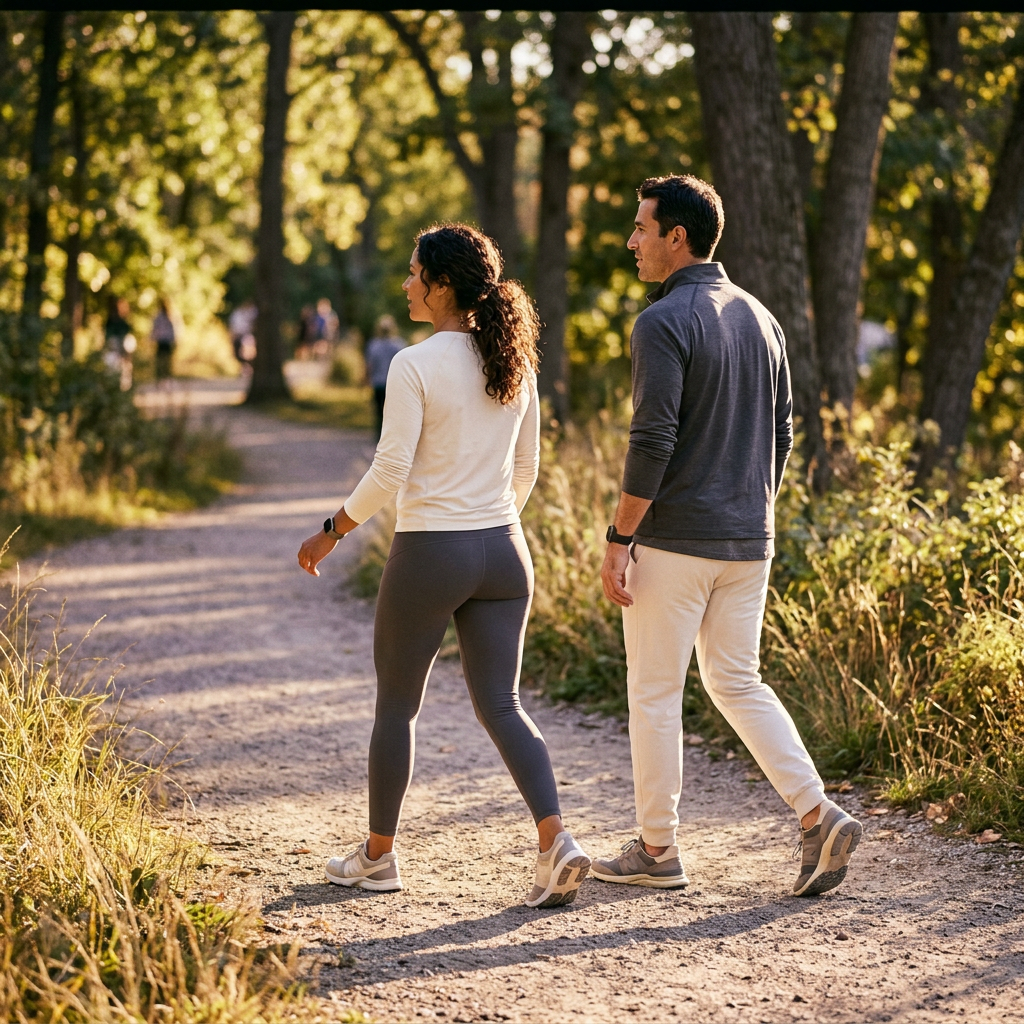
A short walk after eating, even around ten minutes, can meaningfully blunt the post-meal glucose spike in many adults. Muscle contraction pulls glucose out of the bloodstream through a pathway that does not require insulin, which is why light walking after meals tends to lower peak glucose and shorten the time spent elevated.
If you have ever watched a continuous glucose monitor after a bowl of pasta, you have seen the shape of the problem: a steep climb, a wobbly plateau, a slow descent. The intervention with the best evidence-to-effort ratio for flattening that curve is not a supplement. It is a short walk.
Ten minutes of easy walking, started within about half an hour of finishing a meal, can meaningfully reduce the post-meal glucose peak in many adults. It is not a cure for anything. It is a lever — a small, repeatable one — on a physiologic process that most of us run through three or more times a day.
Why a walk moves glucose at all — in plain English
When you eat carbohydrate, glucose enters the bloodstream and insulin rises to escort it into cells. In insulin resistance, that handoff gets sluggish, and glucose lingers.
Muscle contraction opens a second door. Working skeletal muscle recruits GLUT4 transporters to the cell surface through a pathway that does not require insulin at all. Glucose moves from blood into muscle because the muscle is using it, not because insulin told it to.
That is why even light walking — nothing close to a workout — pulls glucose out of circulation during and shortly after the activity. The mechanism is well characterized in exercise physiology reviews.
What the trials actually measured
A 2016 randomized crossover study in adults with type 2 diabetes compared a single 30-minute daily walk to three 10-minute walks taken after each main meal. The post-meal walking arm produced a greater reduction in post-meal glucose, with the biggest effect after the evening meal.
An earlier study in older adults at risk for impaired glucose tolerance found that three 15-minute post-meal walks improved 24-hour glycemic control compared with a single sustained walk of equivalent duration.
A 2022 systematic review and meta-analysis looked at interrupting prolonged sitting with short bouts of standing or light walking. Light-intensity walking breaks produced meaningful reductions in post-meal glucose and insulin compared with uninterrupted sitting. Standing alone helped less than walking.
The pattern across these studies is consistent: short, light, timed movement after eating does more for post-meal glucose than the same minutes done at a random time.
How soon, how long, how fast
The practical window appears to be the first 30 to 60 minutes after a meal — roughly when glucose is on its way up. Starting the walk within 15 to 30 minutes of finishing is a reasonable target based on the trial protocols.
Duration in the published work ranges from about 10 to 15 minutes per bout. Intensity is deliberately low: a conversational pace, not a workout.
- Timing: start within ~30 minutes of finishing the meal
- Duration: 10–15 minutes is where the evidence sits
- Intensity: easy enough to talk in full sentences
- Frequency: after the meals that spike you most — often dinner
The one takeawayA ten-minute easy walk after a meal uses an insulin-independent pathway to pull glucose into muscle, which is why it blunts the post-meal spike more reliably than the same minutes walked at a random time of day.
Who is likely to notice the biggest effect
Tuned to your numbers, the response is not uniform. People with higher post-meal glucose excursions — prediabetes, type 2 diabetes, or simply a carb-heavy meal — tend to see the largest absolute drop in peak glucose. People whose glucose barely moves after meals have less room to improve.
The American Diabetes Association's position statement on physical activity recommends breaking up prolonged sitting with light activity every 30 minutes, specifically because of the post-meal glucose benefit. That recommendation sits alongside, not instead of, structured aerobic and resistance training.
If you wear a CGM, the cleanest personal experiment is to eat the same meal on two different days — one sedentary, one followed by a short walk — and compare the curves. Most people see a visibly lower peak and a faster return to baseline on the walking day.
Where it fits in a real training week
A post-meal walk is not a replacement for cardiorespiratory or resistance training. ACSM guidance for general health still points to roughly 150 minutes per week of moderate aerobic activity plus two sessions of resistance training. The post-meal walk is additive — a glucose-management tool, not a fitness-building one.
Think of it as hygiene, like brushing after meals. It is small, it is repeatable, and the benefit shows up in the same hour you do it.
The best intervention is the one that fits into the life you already have. A ten-minute walk after dinner qualifies.
What a post-meal walk will not do
It will not reverse insulin resistance on its own. It will not substitute for the glycemic effect of losing visceral fat, improving sleep, or building muscle through resistance training. It will not fix a meal that was poorly tolerated to begin with — though it will soften the curve.
And it is not a reason to skip clinical workup if your fasting glucose, HbA1c, or post-meal numbers are drifting. The labs worth having on hand before any serious metabolic conversation include fasting glucose, HbA1c, a fasting insulin, and a lipid panel — those let a clinician see the pattern, not just a snapshot.
The bottom line
Ten minutes of easy walking after meals is one of the most evidence-supported, lowest-cost moves in metabolic health. The mechanism is real, the trials are consistent, and the effect shows up the same day. It is not dramatic. It does not have to be.
References
- Buffey AJ, Herring MP, Langley CK, Donnelly AE, Carson BP. The Acute Effects of Interrupting Prolonged Sitting Time in Adults with Standing and Light-Intensity Walking on Biomarkers of Cardiometabolic Health in Adults: A Systematic Review and Meta-analysis. Sports Medicine. 2022. Source
- Reynolds AN, Mann JI, Williams S, Venn BJ. Advice to walk after meals is more effective for lowering postprandial glycaemia in type 2 diabetes mellitus than advice that does not specify timing: a randomised crossover study. Diabetologia. 2016. Source
- DiPietro L, Gribok A, Stevens MS, Hamm LF, Rumpler W. Three 15-min bouts of moderate postmeal walking significantly improves 24-h glycemic control in older people at risk for impaired glucose tolerance. Diabetes Care. 2013. Source
- Colberg SR, Sigal RJ, Yardley JE, et al. Physical Activity/Exercise and Diabetes: A Position Statement of the American Diabetes Association. Diabetes Care. 2016. Source
- Richter EA, Hargreaves M. Exercise, GLUT4, and skeletal muscle glucose uptake. Physiological Reviews. 2013. Source
Real protocols, built around your bloodwork.
DirectCare AI prescribes hormone, weight-loss, and longevity protocols designed to layer on top of the training and nutrition habits that actually move outcomes.
Start an intake →Editorial disclosure: This article is for informational purposes only and does not constitute medical advice. All treatments at DirectCare AI are prescribed by US-licensed clinicians based on individual medical evaluation. Compounded medications are not FDA-approved and are not reviewed by the FDA for safety, effectiveness, or quality. Always consult a US-licensed clinician before starting or changing any therapy.