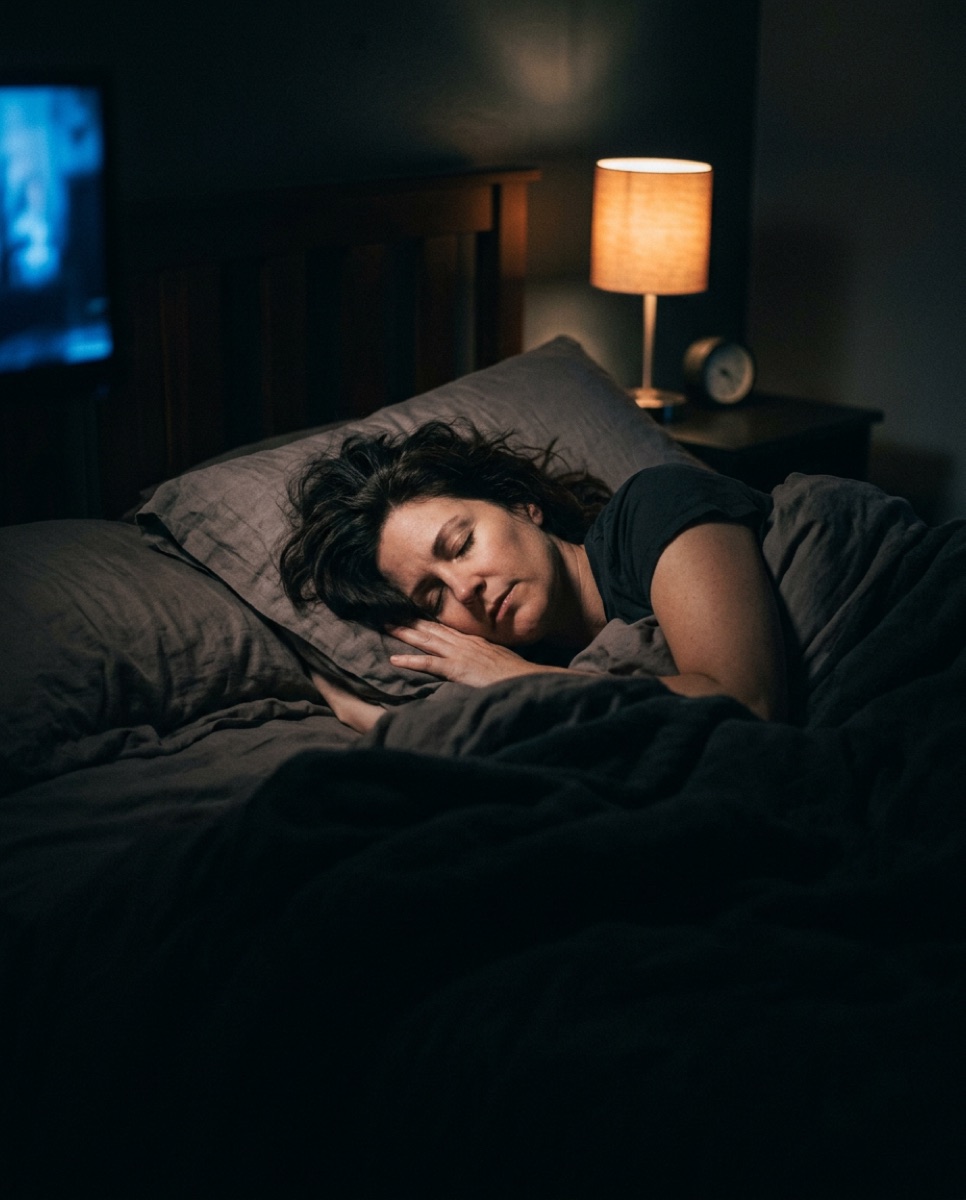
In a 2022 Northwestern University study, healthy adults who slept one night in moderate room light (100 lux) had a higher heart rate during sleep and higher insulin resistance the next morning than adults who slept in near darkness (under 3 lux).
A television left on, a hallway light through an open door, a lamp you fell asleep under. Light in the bedroom at night is common, and most people assume closed eyes shut it out. A sleep laboratory at Northwestern University tested that assumption.
What the study did
Healthy young adults spent two nights in the lab. One group slept both nights in dim light, under 3 lux, which is close to darkness. The other group slept the first night in dim light and the second night in moderate light of 100 lux. That is comparable to a dimly lit room.
Researchers recorded sleep and heart activity through the night and tested how the body handled glucose the next morning.
What it found
After one night in the lit room, compared with the dim room:
- Heart rate during sleep was higher
- Heart rate variability was lower, a sign the body's alert system stayed more active
- Insulin resistance the next morning was higher
The participants were asleep with their eyes closed. Their bodies still registered the light.
Why light would matter
Eyelids block only part of the light that reaches them. The authors' explanation is that light during sleep keeps the nervous system in a more alert state, which raises heart rate, and that this state also makes cells respond less well to insulin.
How to darken a bedroom
- Turn the television off before sleep, or set a sleep timer
- Cover or unplug chargers and devices with bright indicator lights
- Use blackout curtains or a sleep mask if street light comes in
- If you need a night light for safety, choose a dim, warm-colored one and place it near the floor
Sleep experts recommend seven or more hours a night for adults. Our article on one night of short sleep and insulin sensitivity covers what lost sleep does to the same system.
When to talk with a clinician
Loud snoring, pauses in breathing, or daytime sleepiness that does not improve with more sleep are worth an assessment.
This article is educational and is not medical advice. Talk with a licensed clinician about your own health.
References
- Mason IC, Grimaldi D, Reid KJ, et al. Light exposure during sleep impairs cardiometabolic function. Proc Natl Acad Sci U S A. 2022;119(12):e2113290119. Source
- Watson NF, Badr MS, Belenky G, et al. Joint Consensus Statement of the American Academy of Sleep Medicine and Sleep Research Society on the Recommended Amount of Sleep for a Healthy Adult. J Clin Sleep Med. 2015;11(8):931-952. Source
Real labs. Plain-English plan.
A clinician-ordered, 80+ biomarker panel. Results in 3–5 days, with a personalized roadmap from a US-licensed clinician — not a chart you have to decode yourself.
See my numbers → →Editorial disclosure: This article is for informational purposes only and does not constitute medical advice. All treatments at DirectCare AI are prescribed by US-licensed clinicians based on individual medical evaluation. Compounded medications are not FDA-approved and are not reviewed by the FDA for safety, effectiveness, or quality. Always consult a US-licensed clinician before starting or changing any therapy.