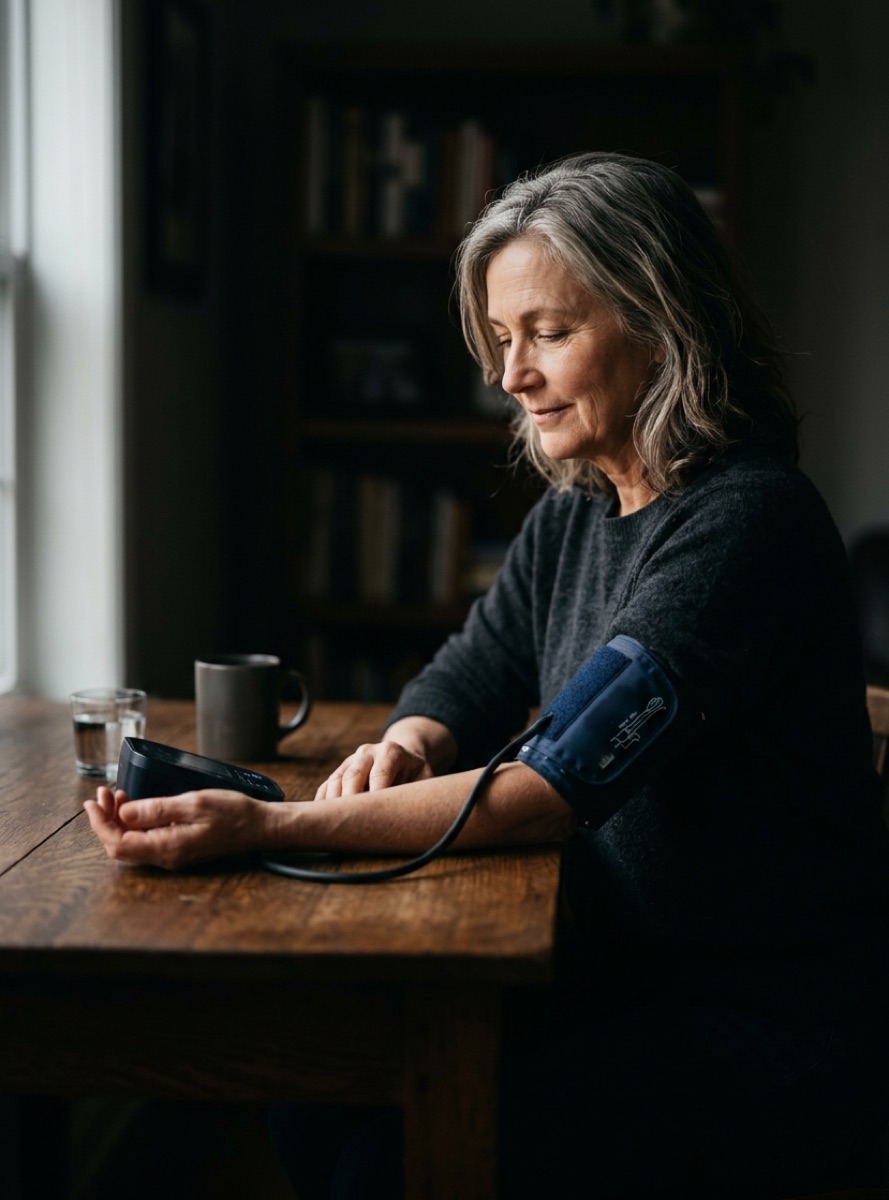
In the 2024 ARMS trial of 133 adults, a blood pressure reading taken with the hand resting in the lap was about 4 mm Hg higher on both numbers than one taken with the arm supported on a desk. With the arm hanging at the side, the top number read 6.5 mm Hg higher and the bottom number 4.4 mm Hg higher.
Guidelines say blood pressure should be measured with the arm supported and the cuff at the level of the heart. In practice, readings are often taken with the arm resting in the lap or hanging beside an exam table. Researchers at Johns Hopkins measured how much that changes the result.
What the trial did
The ARMS trial enrolled 133 adults aged 18 to 80 in Baltimore. Each person had sets of three readings taken in three positions, in random order:
- Arm supported on a desk, the recommended position
- Hand resting in the lap
- Arm hanging unsupported at the side
A fourth set, again on the desk, let the researchers account for normal variation between readings.
What it found
Compared with the desk position:
- Lap: the top number (systolic) read 3.9 mm Hg higher and the bottom number (diastolic) 4.0 mm Hg higher
- Side: systolic read 6.5 mm Hg higher and diastolic 4.4 mm Hg higher
The pattern held across age groups, body sizes and people with and without high blood pressure.
Why a few points matter
In US guidelines, stage 1 high blood pressure starts at 130 over 80. A person whose true reading is 124 could be recorded at 130 or above because of where the arm was. The authors noted that the error could lead to people being told they have high blood pressure when they do not.
How to take a reading you can trust
- Avoid caffeine, exercise and smoking for 30 minutes beforehand
- Empty your bladder, then sit quietly for five minutes
- Sit in a chair with your back supported, feet flat and legs uncrossed
- Rest your arm on a table so the middle of the cuff is level with your heart
- Place the cuff on bare skin, and use a cuff that fits your arm
- Stay silent during the reading
- Take two readings a minute apart and write both down
When to talk with a clinician
One high reading is not a diagnosis. If home readings are regularly at or above 130 over 80, bring your log to a licensed clinician. Seek emergency care for a reading above 180 over 120 with chest pain, shortness of breath, vision changes or weakness.
This article is educational and is not medical advice. Talk with a licensed clinician about your own health.
References
- Liu H, Zhao D, Sabit A, et al. Arm Position and Blood Pressure Readings: The ARMS Crossover Randomized Clinical Trial. JAMA Intern Med. 2024;184(12):1436-1442. Source
- Whelton PK, Carey RM, Aronow WS, et al. 2017 ACC/AHA/AAPA/ABC/ACPM/AGS/APhA/ASH/ASPC/NMA/PCNA Guideline for the Prevention, Detection, Evaluation, and Management of High Blood Pressure in Adults. Hypertension. 2018;71(6):e13-e115. Source
Real labs. Plain-English plan.
A clinician-ordered, 80+ biomarker panel. Results in 3–5 days, with a personalized roadmap from a US-licensed clinician — not a chart you have to decode yourself.
See my numbers → →Editorial disclosure: This article is for informational purposes only and does not constitute medical advice. All treatments at DirectCare AI are prescribed by US-licensed clinicians based on individual medical evaluation. Compounded medications are not FDA-approved and are not reviewed by the FDA for safety, effectiveness, or quality. Always consult a US-licensed clinician before starting or changing any therapy.